
In this Article:
01: How to read your results: green, yellow and red indicators02: Your cholesterol results explained03: BMI, heart age, and cardiovascular risk04: Lifestyle factors that affect heart health 05: How can I make changes to improve my heart health?06: Don’t forget – we’re here to help 07: Frequently asked questions
How to read your results: green, yellow and red indicators
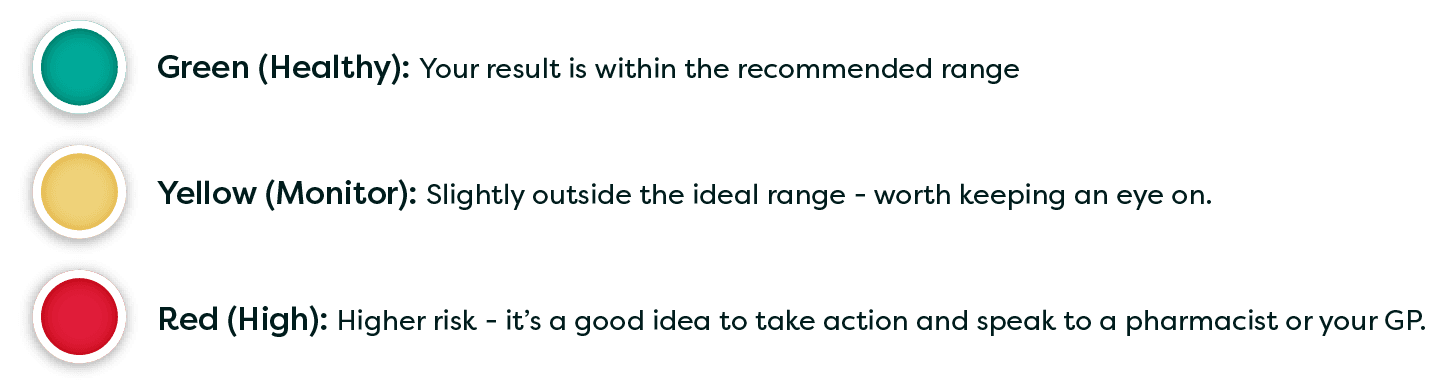
Your PocDoc Healthy Heart check results use a simple colour system.
These colours appear across your cholesterol results, body mass index (BMI), and your cardiovascular risk assessment.

Your cholesterol results explained
Your test includes a full cholesterol blood panel.
Cholesterol is a fatty substance in our bodies that’s needed to support a range of internal functions, from digesting fats in our food to helping produce vitamin D. We need a certain amount of cholesterol to carry out these processes and maintain healthy cells. However, when cholesterol levels become too high, it can start to build up in the arteries, narrowing them and making it harder for blood to flow freely. Over time, this can increase the risk of serious health problems, including heart disease and stroke, turning an essential substance into a potential threat when present in excess.
You can learn more about cholesterol here.
Here’s what each part of your cholesterol test means.
Total Cholesterol
This is the overall amount of cholesterol in your blood. Cholesterol is essential for your body, too much can block your blood vessels, making you more likely to have heart problems or a stroke.
Green: Healthy range
Yellow: Slightly raised
Red: High - worth discussing with a pharmacist or your GP
It’s important to note that even if your total cholesterol result appears in the green range, other markers like Non‑HDL cholesterol may still be raised. A green result doesn’t always mean everything is in a healthy range, so it’s helpful to look at all cholesterol measures together to get a good overall picture of your health.
HDL Cholesterol
HDL, sometimes called “good” cholesterol, helps remove harmful cholesterol from your bloodstream. A higher HDL is generally better.
Green: Protective
Yellow: Lower than ideal
Red: Low - may increase risk
Non‑HDL Cholesterol (includes LDL)
Non‑HDL is harmful in excess, and includes all the “bad” types of cholesterol, including LDL. This is often more accurate than LDL alone.
LDL and HDL are often compared to understand balance
Lower non‑HDL is better for heart health
Green: Healthy
Yellow: Slightly raised
Red: High - linked with higher cardiovascular risk
Triglycerides
Triglycerides are a type of fat in your blood. High levels can increase your risk for health problems such as heart disease, liver disease, and diabetes. Common factors that may increase your levels include a high-fat or high-sugar diet, low activity levels, or even having a non-fasting blood test.
Green: Healthy
Yellow: Slightly raised
Red: High - worth reviewing lifestyle factors
Total cholesterol/HDL ratio
This ratio compares your total cholesterol to your HDL. A lower ratio means better protection for your heart, where a higher ratio shows an increased risk of heart disease.
Green: Low ratio - lower risk
Yellow: Moderate ratio
Red: High ratio - higher risk

BMI, heart age, and cardiovascular risk
Your results also include important indicators beyond cholesterol.
BMI
BMI compares your weight to your height. It’s not a perfect measure as it doesn’t factor in muscle mass, but it helps identify whether weight may be affecting your heart health. A higher BMI can increase the risk of high blood pressure, diabetes and heart disease.
QRISK: your 10‑year cardiovascular risk assessment
QRISK estimates your chance of having a heart attack or stroke in the next 10 years. It uses:
Age
Sex
Ethnicity
Cholesterol levels
Blood pressure indicators
Lifestyle factors
A higher score reflects a higher statistical risk. This doesn’t mean something will happen - only that, based on large population studies, your chances are higher than average. This is a guide to help you understand your health and make informed choices, not a prediction of a guaranteed event.
Heart age
Your heart age compares your cardiovascular health to the average person of your age.
For example, if you’re 45 but your heart age is 55, it means your risk factors are higher than expected. Understanding your heart age can help you make positive changes.
Lifestyle factors that affect heart health
Your results may be influenced by everyday habits, including:
Diet
Exercise
Smoking
Alcohol
Sleep
Stress
Small changes can make a big difference to your cardiovascular health.
How can I make changes to improve my heart health?
Caring for your heart doesn’t have to mean overhauling your entire life - small, consistent choices can create powerful change. Regular movement, even a brisk walk, strengthens your heart and improves your cholesterol and blood pressure. Choosing more whole foods, healthy fats, and fibre-rich meals supports your arteries and helps keep triglycerides in check. Prioritising good sleep, managing stress in ways that genuinely work for you, and limiting alcohol all contribute to a healthier cardiovascular system. And because heart issues are often silent, keeping an eye on your numbers with routine check‑ups gives you the chance to act early.
Heart health isn’t about perfection; it’s about building habits that help your body thrive over time.
Don’t forget – we’re here to help
As part of the Healthy Hearts Programme, you can book a free telephone appointment with one of our pharmacists. They’ll talk through your results, answer questions and help you take the next steps for your heart health.
Frequently asked questions
They show your cholesterol levels, BMI, heart age and cardiovascular risk. Together, these help you understand your overall heart health.
Healthy ranges vary, but generally:
Higher HDL is good
Lower non‑HDL and triglycerides are better
Your colour indicators help you understand where you sit.
Heart age compares your cardiovascular health to the average person of your age. A higher heart age means higher risk.
Triglycerides are fats in your blood. High levels can increase the risk of heart disease.
BMI helps identify whether weight may be affecting your heart health. Higher BMI can increase cardiovascular risk.
Small changes help:
Eating more fibre and healthy fats
Moving more
Reducing alcohol
Managing stress
Stopping smoking
HDL is “good” cholesterol that protects your heart by clearing cholesterol out of the arteries.
LDL (part of non‑HDL) is “bad” cholesterol that can build up in arteries.
Explore heart health essentials in our Health & Wellness Shop


Other articles you might like
Shop for heart health
Back to Heart Health